Few things get historians more excited than discovering new sources. That's what has happened to Davis Houck, a professor at Florida State University and the author of a book about media coverage of the infamous Emmett Till murder. Till was the 14-year-old boy who allegedly whistled at a white woman and was brutally killed.
The trial of the two men accused of the murder drews reporters from the white and black press. Houck has studied the reporting of the trial, but a few years ago found that that another black newspaper, the St. Louis Argus, also had a journalist there. The problem was that the newspaper's archive was missing.
But recently Houck and his students at FSU discovered the missing issues in a historical archive in Missouri. The discovery is already a treasure trove, with
never-before-seen pictures of the NAACP's Medgar Evers, as well as stories written during the trial. "This is just going to be another layer for us to process," he told National Public Radio. "Another layer of what it was like to be black in the Jim Crow South
covering this case."
Monday, April 1, 2013
Sunday, March 31, 2013
Media Myth blog outstanding
Joe Campbell's "Media Myth Alert" is one of the best blogs about mass media history. Campbell, a professor of journalism at American University, is the author of several books, including Getting it Wrong. His blog calls attention to media-driven myths.
In a recent post, Campbell revisits what he calls the Washington Post's "thoroughly innacurate" story about U.S. Army Private Jessica Lynch 10 years ago. In a front-page story, the Post said that Lynch, a supply clerk who never expected to see combat, fought fiercely during an ambush in the first major battle of the Iraq War. As Campbell notes, it was an electrifying report that proved to be "spectacularly wrong" and reverberated widely.
Campbell does not mince words in his blog, one of the things that makes it so valuable. A former reporter, he knows that journalists often do outstanding work, but they also are far from perfect. And as he rightly points out, the same can be said for historians writing about the media.
In a recent post, Campbell revisits what he calls the Washington Post's "thoroughly innacurate" story about U.S. Army Private Jessica Lynch 10 years ago. In a front-page story, the Post said that Lynch, a supply clerk who never expected to see combat, fought fiercely during an ambush in the first major battle of the Iraq War. As Campbell notes, it was an electrifying report that proved to be "spectacularly wrong" and reverberated widely.
Campbell does not mince words in his blog, one of the things that makes it so valuable. A former reporter, he knows that journalists often do outstanding work, but they also are far from perfect. And as he rightly points out, the same can be said for historians writing about the media.
Friday, February 8, 2013
"On the Road" profiles Penn State's mailman

A couple of years ago, the CBS Evening News brought back the popular feature, "On the Road." The segment, now hosted by Steve Hartman, still covers feel-good stories about people, places and events. Tonight "On the Road" profiled one of my favorite people at Penn State, Mike Herr, better known as "Mike the Mailman." Mike is so beloved because he always has a kind word for customers at the campus post office.
Sunday, January 13, 2013
Crusading editor Eugene Patterson dies
Eugene Patterson, an editorial voice of conscience in the South during the Civil Rights era, died yesterday. Patterson was the editor of the Atlanta Constitution from 1960-1968 and wrote powerful columns condemning the violence and miscarriages of justice against blacks.
At the ruins of the 16th Street Baptist where a bomb killed four young girls in 1963, Patterson wrote his most most famous column, “A Flower for the Graves.” Walter Cronkite was so moved that he asked the editor to read it on the “CBS Evening News.” The column began: “A Negro mother wept in the street Sunday morning in front of a Baptist Church in Birmingham. In her hand she held a shoe, one shoe, from the foot of her dead child. We hold that shoe with her. Every one of us in the white South holds that small shoe in his hand.
Patterson later served as managing editor of the Washington Post and as editor of the St. Petersburg Times. A collection of his columns for The Constitution was published as a book, “The Changing South of Gene Patterson: Journalism and Civil Rights, 1960-1968.”
At the ruins of the 16th Street Baptist where a bomb killed four young girls in 1963, Patterson wrote his most most famous column, “A Flower for the Graves.” Walter Cronkite was so moved that he asked the editor to read it on the “CBS Evening News.” The column began: “A Negro mother wept in the street Sunday morning in front of a Baptist Church in Birmingham. In her hand she held a shoe, one shoe, from the foot of her dead child. We hold that shoe with her. Every one of us in the white South holds that small shoe in his hand.
Patterson later served as managing editor of the Washington Post and as editor of the St. Petersburg Times. A collection of his columns for The Constitution was published as a book, “The Changing South of Gene Patterson: Journalism and Civil Rights, 1960-1968.”
Sunday, September 30, 2012
Lincoln on the press
Here's a quote from Abraham Lincoln that shows why he was one of the most media savvy presidents: "The press has no better friend than I am--no one is more ready to acknowledge its tremendous power for both good and evil."
Thursday, September 27, 2012
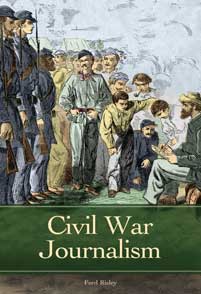
My new book published
Tuesday, September 18, 2012
A Web Site for Old News
The New York Times has an interesting story today about the Library of Alexandria, which is archiving every bit of news produced in the last three years by 20 different television channels. The library also has collected everything published on every Web page for the past 15 years, a monumental goal which already adds up tom more than 150 billion Web pages. The library will be a tremendous resource for future scholars interested in studying the news media.
Subscribe to:
Posts (Atom)